A Deep-Blue World
Hubble observations measured HD 189733 b’s visible-light color as deep blue. The color is associated with its hazy atmosphere and scattering by silicate particles — not an Earth-like ocean.
FOLLOW THE OBSERVATION ↗
BEYOND / EPISODE 02
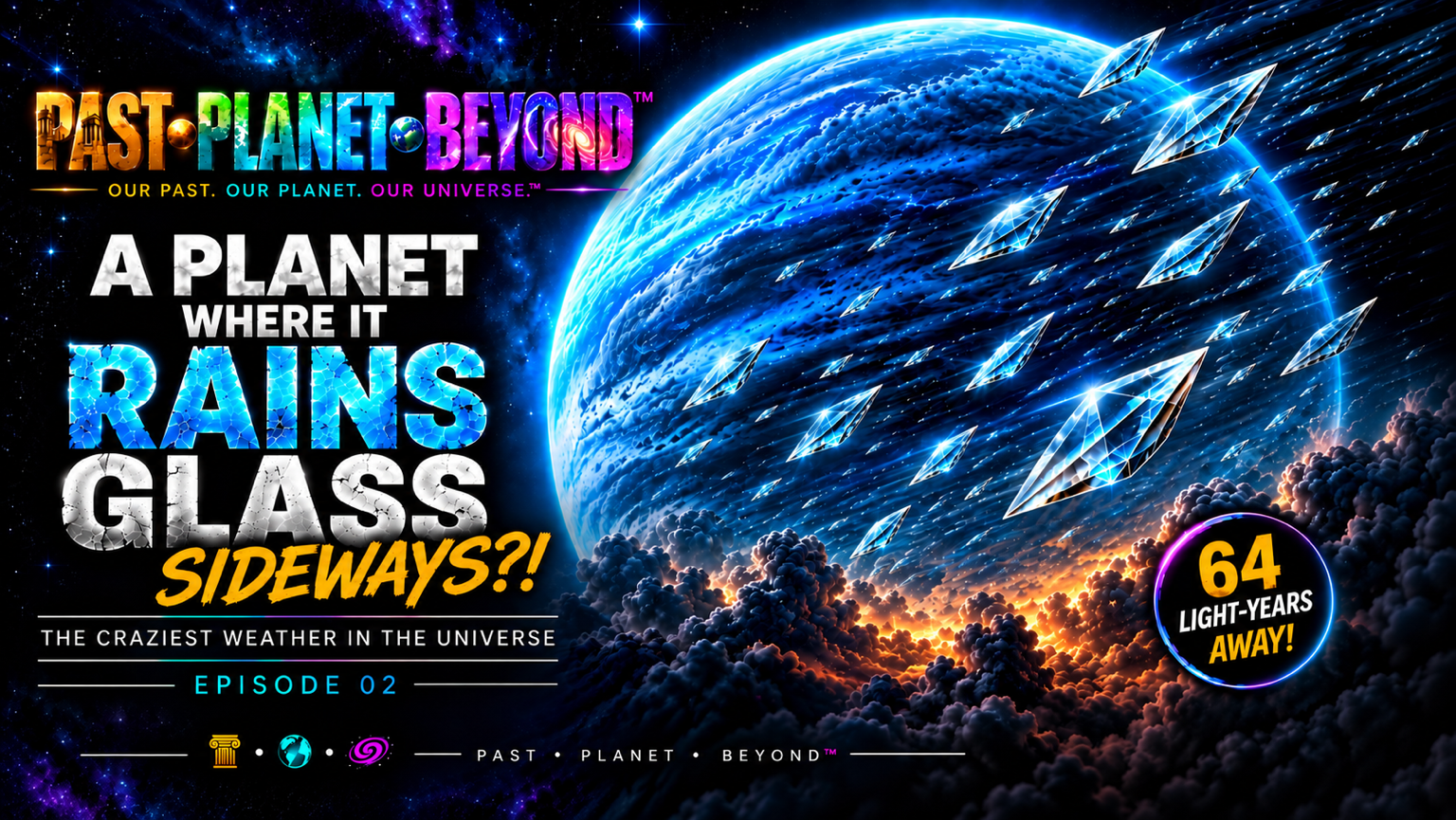
About 64 light-years away, the deep-blue hot Jupiter HD 189733 b has a scorching atmosphere, silicate haze and extreme winds — the ingredients behind one of astronomy’s most unforgettable weather descriptions.
COMING SOON
WATCH THE EXPLORATION
The finished documentary will live here when it premieres. Until then, follow the observations behind the blue world, its atmosphere and its extraordinary weather.
COMING SOON • PAST • PLANET • BEYOND™THE EXPLORATION
02ALIEN WEATHERHD 189733 b is a hot Jupiter orbiting extremely close to its star. Hubble observations established its deep-blue visible-light color, while other observations have helped astronomers map temperatures and measure fierce atmospheric winds.
“Raining glass sideways” is a vivid interpretation of the planet’s atmospheric conditions — not footage or a direct observation of glass shards falling. Silicate particles are implicated in its haze and blue appearance, and extreme winds have been measured; descriptions of glass rain connect those findings with atmospheric models.
FOLLOW THE EVIDENCE
The hook is wild. The observations behind it are even better.
Hubble observations measured HD 189733 b’s visible-light color as deep blue. The color is associated with its hazy atmosphere and scattering by silicate particles — not an Earth-like ocean.
FOLLOW THE OBSERVATION ↗High-resolution spectroscopy has measured winds exceeding 5,400 mph (about 8,700 km/h) in the planet’s atmosphere, moving from its intensely heated day side toward its night side.
FOLLOW THE MEASUREMENT ↗This gas giant circles its star in only about 2.2 days at roughly 0.031 AU. Its close orbit makes HD 189733 b a classic hot Jupiter and an unusually useful target for atmospheric studies.
EXPLORE THE PLANET ↗SOURCE TRAIL
NASA / Hubble · 2013Visible-light color and silicate-cloud interpretation ↗NASA Science · 2015Directly measured atmospheric wind velocities ↗NASA Exoplanet CatalogPlanet type, size, orbit and discovery data ↗Episode 02 is still in production. Additional citations and source notes will be added as the documentary is finalized.
KEEP EXPLORING
Every answer opens another door.
How a world without blue oceans can still look startlingly familiar from afar.
DEEPER EXPLORATION COMING SOONSeparate the measured observations from the atmospheric interpretation behind the famous phrase.
DEEPER EXPLORATION COMING SOONMeet the giant planets that orbit astonishingly close to their stars.
DEEPER EXPLORATION COMING SOONThere’s always another story.
VISUAL & PRODUCTION NOTE
Past • Planet • Beyond™ may use illustrations, animation, visual effects, recreations, archival or stock material, and AI-assisted or AI-generated media to visualize subjects that cannot be directly photographed. Representational visuals are not presented as direct documentary footage when they are not.
READ OUR EDITORIAL & CONTENT DISCLAIMER →THE JOURNEY CONTINUES
“THE CRAZY PART HAS TO BE TRUE™.”
Wonder gets our attention. Evidence earns the story.
← RETURN HOME